
'Quiet back channel advice will probably be rendered by Saudi Arabia to India that international perception on both issues does not favour India and that it should be prudent to look inwards and introspect on where the failing has been,' notes Lieutenant General Syed Ata Hasnain (retd).

Apprehending attack by Pakistan's Border Action Team on forward posts and patrol parties in the run up to Republic Day, Army has sounded an alert along the boundary with Pakistan in Jammu and Kashmir.

In the wake of stone pelting incidents and alleged presence of Islamic State flag during a rally in Srinagar, Army on Thursday said it is closely monitoring the situation and the issue was getting the highest concern of all security agencies.

The Army on Thursday said there were inputs about possibility of attacks by Pakistan-based terror outfits on "soft targets" such as schools, religious places, military convoys and civilian areas in Jammu and Kashmir ahead of US President Barack Obama's India visit later this month.
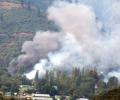
'Knee jerk reactions are the worst in this kind of conflict situation.' 'The responses have to be thought through for strategic advantage rather than tactical satisfaction and ego,' says Lieutenant General Syed Ata Hasnain (retd), former commander of the Uri-based Kalapahar Brigade.

The Pampore attack 'has the stamp of LeT written all over it.'
'They are exactly like the so-called fidayeen of the 1999-2003 phase, when J&K witnessed a surge in suicide attacks on various important garrisons,' says Lieutenant General Syed Ata Hasnain (retd), who served as the General Officer Commanding 15 Corps in Kashmir.

On the title page of the Top Secret Report, Henderson-Brooks quotes the Chinese tactician Sun Tzu: 'Know yourself, know your enemy: A hundred battles, a hundred victories', says Claude Arpi, highlighting where the Indian Army and government failed to counter the Chinese attack in 1962.
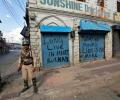
Separatists and their wide network must be neutralized for peace in the Valley

"Each soldier was my brother in arms.' 'We fought together and achieved glory for India.' 'We fought on with only one thing in the mind -- that that this is a national battle and we must not let the Pakistanis get the better of us,' says Major General Shamsher Singh, who was awarded the Mahavir Chakra for fighting in one of the bloodiest battles the Indian Army has ever waged.

Pundits in Pakistan and also some western diplomats are predicting that the next army chief will be forced, partly by institutional pressure and partly by circumstances, to indulge in some tough talking with the civilian leadership. How the civil-military equation settles in this sort of a situation is something that will determine the future of Pakistani politics, and also Pakistan's relations with rest of the world, says Sushant Sareen.

Lieutenant General J F R Jacob, Chief of Staff, Eastern Army Command during the 1971 war, revealed how, armed with only a draft surrender document and an aide, he made the Pakistani army led by Lieutenant General A A K Niazi surrender.
Lieutenant General J F R Jacob, Chief of Staff, Eastern Army Command during the 1971 war, revealed how, armed with only a draft surrender document and an aide, he made the Pakistani army led by Lieutenant General A A K Niazi surrender.
Lieutenant General J F R Jacob, Chief of Staff, Eastern Army Command during the 1971 war, revealed how, armed with only a draft surrender document and an aide, he made the Pakistani army led by Lieutenant General A A K Niazi surrender.
Lieutenant General J F R Jacob, Chief of Staff, Eastern Army Command during the 1971 war, revealed how, armed with only a draft surrender document and an aide, he made the Pakistani army led by Lieutenant General A A K Niazi surrender.
Lieutenant General J F R Jacob, Chief of Staff, Eastern Army Command during the 1971 war, reveals how, armed with only a draft surrender document and an aide, he made the Pakistani army led by Lieutenant General A A K Niazi surrender.
